
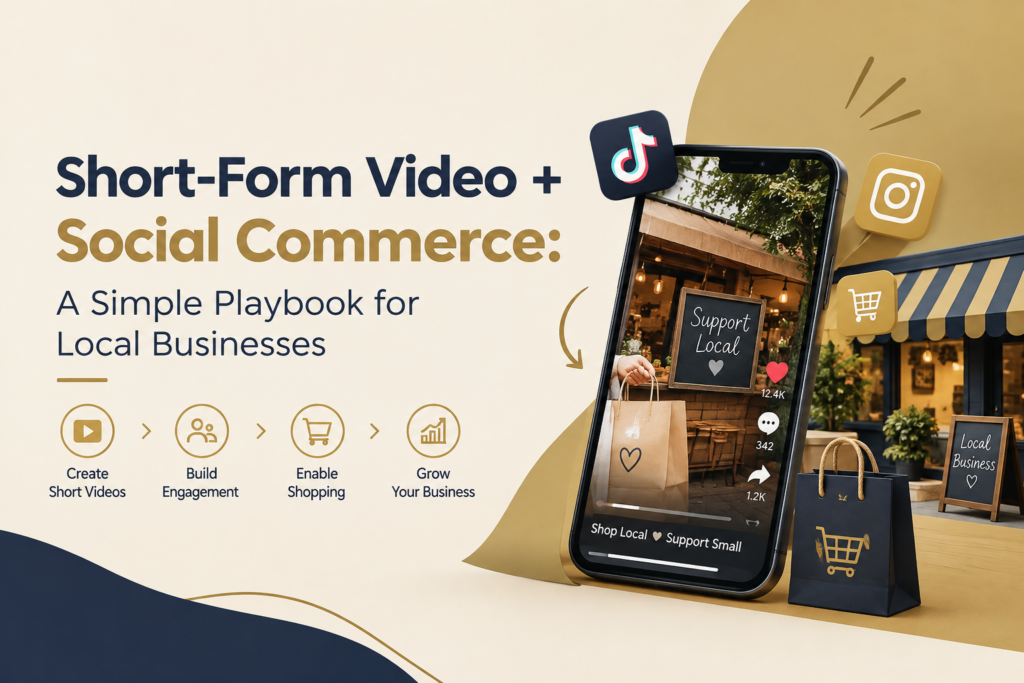
Short-Form Video + Social Commerce: A Simple Playbook for Local Businesses
Introduction
People scroll fast. If your content doesn’t stop them in the first two seconds, they’re gone. But short-form video is doing exactly that for businesses right now — stopping the scroll, building real connections, and driving more organic reach than almost any other content format.
Two trends are standing out in 2026: short-form video and social commerce. The good news is they work incredibly well together, especially for local businesses. This is a straightforward, practical playbook — no production team, no big budget, no complicated tech. Just a clear plan any local business owner can follow to turn video views into customers.
Why Short-Form Video Matters for Local Businesses
People used to Google a local café or salon and check a few reviews. Now they’re finding local businesses through Reels, TikTok, and YouTube Shorts — scrolling past a 15-second clip and tagging a friend before they’ve even thought about searching.
Here’s why that matters:
It builds trust faster than static posts. A video showing the real product, space, and people behind a business builds confidence faster than a photo ever could. People feel like they know you before they walk through the door.
The algorithm rewards video with more reach. Platforms actively push short-form video to people who don’t follow you yet — meaning you can grow without spending on ads. A phone-filmed Reel can outperform a polished static post.
It levels the playing field. Big brands have budgets, but they don’t have your story or your community. A local business showing its real, behind-the-scenes side almost always feels more trustworthy than a corporate ad.
Why Social Commerce Is the Natural Next Step
Someone watches your video and thinks, “I want that.” If they have to screenshot it, Google your business, find your site, and then check out — you’ve lost half of them. Social commerce closes that gap by letting people buy directly through the platform they’re already on.
-
- Instagram and Facebook Shops let you build a product catalogue and tag products in posts, Reels, and Stories — tap the tag, land on the product page, buy without leaving the app.
-
- TikTok Shop works similarly: pin products to videos, run live shopping, partner with creators. Growing fast, low barrier to entry.
-
- WhatsApp catalogue links suit service businesses or a more personal sales approach — set up a catalogue, share the link, customers browse and enquire directly.
For service businesses (salons, trainers, tutors), the equivalent of “buy” is “book” — a clear booking link, a DM flow, or at minimum an easy-to-find link in your bio. Social commerce isn’t about replacing your website; it’s about removing steps between someone seeing your content and taking action.
The Simple Playbook
Step 1: Pick 1–2 Platforms, Not Five
Trying to post everywhere burns you out fast. Ask where your customers actually spend their time. Café with a 25–40 crowd? Instagram Reels. Younger boutique audience? TikTok. More professional niche? Facebook or YouTube Shorts. Pick one or two, get comfortable, then expand.
Step 2: Film With Your Phone — 3 Content Types That Work
No crew or studio lights needed. Three formats consistently perform:
-
- Behind-the-scenes / day-in-the-life. The morning flower delivery, the prep kitchen, labelling handmade products. It’s real, and real is what people are curious about.
-
- Before-and-after or product-in-use. A messy room vs. the finished clean, a client’s progress, raw dough to finished loaf. It’s naturally engaging because it tells a tiny story — and for products, showing real-life use helps people picture themselves with it.
-
- Quick customer testimonial or FAQ answer. A 15-second clip of a real customer’s honest praise beats any caption. Or answer a question customers always ask — useful, shareable, and it positions you as the expert.
Step 3: Add a Simple, Clear Call-to-Action
Don’t assume people know what to do next — tell them. Keep it to one action per video:
-
- “DM us to book your appointment”
-
- “Link in bio to shop”
-
- “Tap the tag to grab yours”
-
- “Comment below if you want one”
Don’t ask for a follow, a share, a comment, and a purchase in the same breath. Pick one.
Step 4: Connect the Shop
If you sell physical products, set up Instagram/Facebook Shop or TikTok Shop — it’s free and simpler than it used to be. Tag products in videos where it makes sense, and let the tag do the selling. For service businesses, keep your booking link in your bio and mention it in the video itself: “link in bio to book” said once at the end works.
Step 5: Post Consistently, Not Perfectly
The most important step, and the one most owners get wrong. One beautifully edited video a month isn’t a strategy — two or three simple phone-filmed videos a week is. The algorithm needs volume and consistency to learn who to show your content to. Early views will be low; that’s normal. A simple rhythm:
-
- Monday: behind-the-scenes clip
-
- Wednesday: product-in-use or before-and-after
-
- Friday: testimonial or FAQ answer
Batch-film all three in one afternoon. Consistency beats perfection every time.
Common Mistakes Local Businesses Make
Treating video like a TV ad. Polished, scripted content performs badly in a feed people are scrolling for entertainment. Talk to the camera like a friend, show the mess as well as the result, be a person rather than a brand persona.
No clear next step for the viewer. A great video that ends with no CTA, no shop link, no “DM us to book” leaves viewers with nothing to do. Guide them, and make it easy.
Posting once and giving up. Low early views are discouraging, but most accounts don’t hit their stride until 6–8 weeks of consistent posting. The businesses that quit after two weeks never find out what could have happened.
Quick-Start Checklist
-
- Chosen 1–2 platforms where your customers spend time
-
- Set up your shop or catalogue (Instagram, Facebook, or TikTok Shop)
-
- Filmed your first 3 videos (behind-the-scenes, before/after, testimonial or FAQ)
-
- Added a clear CTA to your bio and your posts
-
- Scheduled a consistent posting rhythm (2–3x per week)
That’s the whole starting point.
Closing
You don’t need a big budget, a fancy camera, or a marketing degree. You need a clear setup, a consistent posting habit, and content that actually shows who you are.
The local businesses winning on social media right now aren’t the ones with the most resources — they’re the ones showing up regularly, keeping it real, and making it easy for people to take the next step.
If you’d like help setting up your social shop, planning your content calendar, or building a posting rhythm that gets results, get in touch — we’ll put together a plan that fits your team, your budget, and your goals.